Wool poems: The Cloak, The Boat And The Shoes

Posted by on Wednesday, November 8th, 2006

So, I’m increasingly obsessed with poems and songs about fiber arts.  Of course I am.  But now I’m going to start posting them here, for my own enjoyment, no matter the protest.  And we’ll just go ahead and categorize them as "wool poems" because that’s much more elegant than "poems on wool, silk, linen, cashmere, yak, ramie, cotton, alpaca, llama, and other fibers, and fiber arts in general."

This is an early piece by William Butler Yeats, whom I love.  Of course I do.  You don’t very well go to the trouble of getting a Masters in Paddy Studies (no, my diploma doesn’t say that) if you don’t love Yeats. 

The Cloak, The Boat And The Shoes

‘What do you make so fair and bright?’

‘I make the cloak of Sorrow:
O lovely to see in all men’s sight
Shall be the cloak of Sorrow,
In all men’s sight.’

‘What do you build with sails for flight?’

‘I build a boat for Sorrow:
O swift on the seas all day and night
Saileth the rover Sorrow,
All day and night.’

What do you weave with wool so white?’

‘I weave the shoes of Sorrow:
Soundless shall be the footfall light
In all men’s ears of Sorrow,
Sudden and light.’

by William Butler Yeats, From Crossways, 1889

Filed in Eating Poetry,wool poems | No responses yet

Equal Protection?

Posted by on Wednesday, November 8th, 2006

I’m backfilling some book reviews, like I do. 

And frankly, Virginia has broken my heart.  I normally keep work and politics off the screen here.  Most people have jobs they don’t love, and most people have political views that they can fight with their neighbors about for hours on end.  I don’t want that here.

But I don’t think I can let yesterday’s election pass without comment.  This Commonwealth, where I’ve spent most of my life, just voted to scar our constitution with bigoted, hateful language that will enshrine homophobia in our Capitol, denying equal protection to a minority that deserves protection and equality, and rip rights away from hetero couples who have chosen not to marry for whatever reason.  It makes me heart-sick. 

I’m trying to console myself with the knowledge that 43% of Virginians said no to the amendment, but it’s cold comfort.  The bigots won, and they’re going to continue to harm people I love, simply because of who those people love.  Traditionally, we amend constitutions in the US to expand freedom and improve the lot of citizens.  Not lately. 

If you think it’s ok to discriminate against homosexuals, don’t bother to tell me.  I don’t want to hear it. 

Filed in blather | 9 responses so far

Land of Women

Posted by on Tuesday, November 7th, 2006

Land of Women: Tales of Sex and Gender from Early Ireland by Lisa M.  Bitel

When I buy a book with a big old Síle na Gig* on the cover, I expect to like it.  Not so much this time around.  It had its good parts, but it also has some big problems. 

First, there’s a problem with the title.  It should be "medieval Ireland."  Early Ireland, to me at least, implies pre-Medieval.  Gimme some Iron Age, damn it. 

Secondly, the author did a good amount of research in the Vitae,  medieval legal tracts like Cain Adomnain, and some mythology.  But oh, what a mistake she made in interpreting the myths.  Frankly, she made a blunder that most Freshman students would make just once, and then they would be so ridiculed by any prof worth even a teaspoon of salt that they would never make it again.

Let me make this clear: There is almost always a huge span of time between when a myth, saga, or epic is composed and when it is transcribed.  Huge.  Hundreds of years.  Imagine how much any society changes in hundreds of years.  Sadly, Bitel conflates the Ireland of the Táin Bó Cúailnge and the Ireland of monks in the scriptorium copying the Táin Bó Cúailnge.  That conflation allows her to make some huge errors in judgment about what the Ireland of the Tain was like for women.  Of course it does. Ireland changed utterly in the span of time between 100 BC or so to the early Christian era.  Tribal systems collapsed, external influences from pre- and post-Christian Rome filtered across the water, invading Northmen found and sacked Britain and Ireland.  Hundreds of years, left out of the explanation.  Badly played, dearie.  Sloppy.

In Old-Irish texts, we know that the monks did not understand the Irish they were transcribing.  It contains linguistic forms that were out-moded and ill-understood by the early medieval period.  Scholars far more qualified than I have dated the language of the Irish epics, and identified the periods in which they were composed.  Doing one’s homework is truly all that’s required for those of us who wish to interpret mythology.  So do it, damn it.  Sheesh.

I get that many scholars want to focus on Patrician Ireland in their studies.  But, as in all forms of scholarship, once you pick your specialty you either need to stick to it or you need to do huge gobs of extra research and work when you decide to branch out.  I don’t think Bitel did.  I think her mind remained ensconced in the context of Patrician Ireland, and that prevented her from better understanding the Ireland of the sagas.  More’s the pity. 

All that said, I’m glad I read the book.  Bitel makes a lot of great points.  But I think her mistake in dates wrecks her thesis, and that’s a shame.  She could have moved the debate forward with this book.  Instead, she negated her own opinions.  She’s wrong when she rails about how powerless women were in ancient Ireland, and she’s wrong because she messed up her dates and neglected her studies. 

* Pronounced Sheila nuh Gee or Sheila nuh Gig (either option with a hard g, by the way).  It means either hag on her haunches, or hag with her breasts out, or one of many other things depending on who you ask.  Most of the Síle na Gigs in Ireland date from the 12c onward.

Filed in Books | 2 responses so far

Glue

Posted by on Tuesday, November 7th, 2006

Glue by Irvine Welsh

Before I get to the meat of the matter, I should take the chance to point out that I love Powell’s Books, and I particularly love the used book trade because it keeps me in hard-to-find imports and it reduces waste and consumption of paper.  These little links to Powell’s theoretically earn me a small commission, should anyone ever use them to buy books I talk about.  No one does.  I’m ok with that.  Just, please, buy lots of books from good people.

Right, so, Glue.  Irvine Welsh wrote Trainspotting, which is one of my favorite books.  Some people read romance novels–I read Scottish/British/Irish/American gen-x/drug/crime/sex/drunkenness/poverty  books by folks like Welsh.  I don’t consider Trainspotting and the like pulp, mind you.  I consider it groundbreaking contemporary fiction.  Welsh’s other books aren’t quite as good as his first, because they’re a bit less compact, and perhaps because the shock of the new has worn off a bit.  But throughout, Welsh writes great coincidences and reconciliations and develops fantastic characters, and Glue has plenty of them. 

What I like about Welsh is his willingness to completely alienate a large portion of his potential readership by covering unsavory topics and writing in blue-collar and underworld Edinbro slang and idiom.  At several moments while I was reading this book on the train, I was a bit embarrassed to be reading his character Terry’s lurid sex tales while sitting next to a nice old lady, but simultaneously comforted by the fact that there was no way she could read it over my shoulder, since it makes no freaking sense until you’ve immersed yourself in Welsh’s wacky system of transcribing Scots.  Speaking of Terry, Welsh doesn’t try too hard to make all of his characters likable.  These boys are given to us straight, warts and all.  It’s great.  Few writers are this brave. 

In this novel, we meet four boys from the scheme (aka housing project), a few years younger than the Trainspotting crew.  We follow them as they grow up and end up dealing with their lot as schemies–we get some football hooliganism, some drug use, some rave-scene ideology, some petty crime, some romance, some tragedy, and a lot of insight into men who have managed to remain friends despite growing utterly apart.  We also get cameos from a few of the Trainspotting crew, which is always fun. 

The book’s a gas.  It’s not Shakespeare, but it still matters. 

Filed in Books | One response so far

Samhain

Posted by on Monday, November 6th, 2006

We held Samhain at John the Ferrier’s this year, which was a big shift from the old 4-H site.  It felt much more intimate and familial than usual.  We camped in the back meadow, which is where we’re building the long hall.  Without the cabins, and with the cold weather, we really did spend most of our time together in one group.  The fires were bigger, the meals were simpler, and I think there was more singing and general "woooohooooo this is fun, let’s  stay up all night"  and less  "oh crap, this is stressful and over-scheduled" than we’ve had in a few Samhains. 

I mentioned cold.  Samhain was cold.  Cuuuuu-holllllddddddd.  I had to skip Friday night, because I was, well, my joints are made of glass, and common sense and my husband and pets ganged up on me.  Friday night was in the teens, which simply does not happen the first weekend in November in Virginia, by the way.  It’s just not done.  Foul play.  I headed down first thing Saturday morning, and was so happy to find everyone hanging out in the (roofless, wall-less) long hall around the fire, as opposed to just shivering or something.

I think Samhain was a true freeze-out, which we haven’t had in ages.  You can tell it’s a freeze out by what it does to attendance: lots of localish regulars bail, but the folks from far away cold places, like Michigan, come and remind all of the Appalachians that it’s not really cold at all.  And things like hot spiced cider and homemade chicken soup become far more prized than beer.  Discussion of layers also marks a freeze-out.  I know I looked like a paper doll, because I was wearing so much that my skirts were truly triangular and my arms were incapable of hanging straight down.   

I got a lot of requests for knitted items from folks.  It was pretty funny, the hinting.  "Boy, those are nice hobo gloves, Lanea.  I love those colors.  I sure like hobo gloves" and "Ooh, a silk-wool hat.  What a good idea.  I bet that’s nice for sleeping at winter camping events.  I love winter camping, but my head is just never warm enough when I go to sleep.  Imagine that."  Message received, everyone.  I’ll see what I can do between now and Imbolc.  Maybe I’ll even have folks come over and knit with me, if we can find a good time. 

I wasn’t taking a lot of pictures.  I got a few, which I’ll add when I find the camera. 

Filed in Celtic | One response so far

Lady Lazarus

Posted by on Friday, November 3rd, 2006

Originally posted by Rachel

As is want to happen with dead poets every now and then, they found another early Sylvia Plath poem. Like most of her juvenilia, it doesn’t do much for me, but read the first paragraph of the introductory essay. It’s pretty righteous. Sing it sister! (Or brother–an author isn’t actually identified.)

Filed in Eating Poetry | No responses yet

The Forge

Posted by on Thursday, November 2nd, 2006

All I know is a door into the dark.
Outside, old axles and iron hoops rusting;
Inside, the hammered anvil’s short-pitched ring,
The unpredictable fantail of sparks
Or hiss when a new shoe toughens in water.
The anvil must be somewhere in the centre,
Horned as a unicorn, at one end square,
Set there immoveable: an altar
Where he expends himself in shape and music.
Sometimes, leather-aproned, hairs in his nose,
He leans out on the jamb, recalls a clatter
Of hoofs where traffic is flashing in rows;
Then grunts and goes in, with a slam and a flick
To beat real iron out, to work the bellows.

This poem is the source for the title of Heaney’s second published collection, Door Into the Dark. As a kid, Heaney passed a farrier’s forge on the way to and from school.  It’s that simple–he takes a common-enough memory and transforms it via vocabulary, compression, and rhythm.  As Rachel and I were discussing a little while ago, there is a strong connection between Heaney and Roethke.  Each poet elevates the everyday, celebrating both beauty and ugliness. 

Poems about blacksmiths are particularly important to those of us who are obsessed with mythology, of course.  In just about any myth system, smiths are also gods or magicians.   In Irish myth, smiths are the kin of Brigid, the goddess of fire and poetry.  Heaney knows this, of course, and "altar" was chosen with purpose in mind.  His smith is the man behind the curtain, working fire and metal and denying access to curious children and onlookers.  And Heaney, as a poet, is now symbolic brother to the smith.  It’s simple, and it’s wonderful.

Now, I know I spend more time with smiths and farriers than does the average American.  I’ve probably done more assistant-smithing than most people will ever dream of, so perhaps it gives me a better or different appreciation of this particular poem.  I’ve heard one person after another complain that Heaney’s work can be too local, even parochial.  I think that’s nonsense.  Heaney’s works shines because of its specificity, because it is so linked to place and time.  Some poets become  so attached to the concept of writing some cosmic truth that they lose all connection to actual experience.  Heaney never does. 

And for people who complain that local works end up being "hard" because true understanding of them requires some preparation or research.  Well, suck it up.  Poetry is considered the most elevated form of literature because it requires consideration and re-reading.  Laziness and drivel needn’t take over our every word, thought, and action.  Maybe I’m a snob.  Or maybe I am just willing to work to find beauty.

Filed in Eating Poetry | No responses yet

The Death of a Student

Posted by on Wednesday, November 1st, 2006

Originally posted by Rachel


Did I mention that the thing I miss most about school is structure? That I can get twice the reading done under the deadlines of a semester than I can in a full year of non-studenthood? All of this is to say, I am a bad, bad blogger. Lanea keeps reassuring me that it’s not school, it’s okay, but I keep secretly hoping she’ll play teacher and give me deadlines.

But something else I learned in school is that it’s easy to bluff when discussing poetry as long as you stick to the ones you’ve actually read. I think they call that “close reading.” Anyone want to call my bluff? Anyone? I didn’t think so. So, yeah, let’s focus particularly on the poems from The Death of a Naturalist. Um, because I’ve read those ones, dang it.

One of the things that I find surprising about Heaney’s work, at least this early work, is how influenced he seems to be by formal verse. Even where there isn’t a set rhyme scheme or particular form in use, his work has such distinctive rhythms and frequent rhyme and off-rhyme, that the poetry often seems to echo that of an earlier time. (I don’t want to tell you how much time I wasted one day trying to figure out if there was a particular form in use in “Ancestral Photograph,” and if so, what might he have been saying by using that form. I failed miserably, in case you’re wondering, though I did find some similarities to Chaucer.) I’m used to John Ashbery’s off-beat tinkerings with villanelles and sestinas and the like, but despite a title about farm implements, they have nothing to do with the poem. Whereas, um, Heaney’s poems actually do. Have to do with farm implements, that is.

So, I spotted some recurring themes in the first book. As the title might indicate, many of the poems here are, in many different ways, about humanity vs. nature. The poet’s father, as in the first poem, “Digging,” is a skilled tamer of nature: “By God, the old man could handle a spade. / Just like his old man.” Heaney, on the other hand, is distracted by other pursuits: ” But I’ve no spade to follow men like them. // Between my finger and my thumb / The squat pen rests. / I’ll dig with it.” While his father and grandfather’s work is the hard labor of digging earth, Heaney is doing a more intimate digging with his pen, digging through his identity and the identity of his family, as he does again in “Follower.”

All I ever did was follow
In his broad shadow around the farm.
I was a nuisance, tripping, falling,
Yapping always. But today
It is my father who keeps stumbling
Behind me, and will not go away.

Here we see something resembling guilt or remorse on the part of the poet, the belief that he has disappointed his father for his ineptitude in farming. His father now follows, or haunts him, because he was not able to live up to what he believed his father’s expectations to be.

As a result of Heaney’s lack of skill with taming nature, nature appears again and again in these poems as something wild and unruly. My favorite example is in “Blackberry-Picking”:

But when the bath was filled we found a fur,
A rat-grey fungus, glutting our cache.
The juice was stinking too. Once off the bush
The fruit fermented, the sweet flesh would turn sour.
I always felt like crying. It wasn’t fair
That all the lovely canfuls smelt of rot.
Each year I hoped they’d keep, knew they would not.

This poem reminds me so strongly of Theodore Roethke, whom I love. The couplet at the end, and the childish hopefulness, it all makes me think of “My Papa’s Waltz,” you know? The childish innocence of always believing something will end well, even when you know from experience that it always turns out the same way. Anyhow, my point was, there’s a lot of gross-out in these poems. I mean, there are no bog bodies here, but there’s slime, mold, rats, drowning kittens, curdled milk. This is not an easy, idyllic nature, but one hard-fought and not always won.

The last selection from this collection, “Personal Helicon”, ties well into the digging theme of the first poem.

Now, to pry into roots, to finger slime,
To stare, big-eyed Narcissus, into some spring
Is beneath all adult dignity. I rhyme
To see myself, to set the darkness echoing.

Heaney still seems to see the act of writing partly through the lens of his father, as a selfish act. But Heaney also sees it as a lens with which to view his “roots”, and that work, he argues, is just as dirty and hard as that of a farmer.


P.S. So, I never did pick the next poet. Shall we do something so obtuse that it will be nearly impossible to discuss? Yes, let’s. Let’s do Ann Lauterbach. Now, the collection I want to do is out-of-print and extremely expensive to acquire……Holy crap, I take that back. Suddenly there are, like 3 copies out there for less than $10. Go get yourself one of those! I spent $75 on a paperback copy of the damn thing. And I spent 8 years searching for a copy that cheap. I need to quell my hoarding instincts before I buy them all myself. I was going to tell you to get the Selected Poems and we’d just read the poems from her first book, and I’d supplement it with some of my favorites not included, but this, of course, is much better.
Filed in Eating Poetry | No responses yet

Sarafina

Posted by on Wednesday, November 1st, 2006

I made a couple of cakes for Rhinebeck.  I think I mentioned.  I love them both, but one is particularly important to me in the larger scheme of things, because it comes down to me from a ways off.  Coincidentally, it’s also the cake that got the most compliments and recipe requests.  I can’t tell you how happy that made me.  A restaurant near our house used to serve a cake almost identical to this one.  The owners’ Mom made it.  She was from Naples.  She stopped making the cake because she was getting on in years and her sons wanted her to take it easy, so we basically don’t go to the restaurant anymore.  Good Bolognese I can make with a little effort.  Lasagna–I don’t want it if someone else makes it.  Chicken Parm–ffffffft, who can’t do that?  This cake?  It takes work.  And it tastes best when a Grandma makes it.  It just does. 

My maternal grandmother, Potensia Florence Marcone, was the child of Italian immigrants.  Her mother, Antoinette, was by all accounts an amazing cook and was a restaurateur for a time in Pittsburgh, where she and her husband settled.  Her mother, Sarafina, made this cake, as did Antoinette, according to my Grandmother.  I was apparently supposed to be named after Sarafina, as she had been named after her great-great, but no one told my Mom in time.  Some family traditions are easily lost.  This cake hasn’t been, though we came close.  It’s apparently very common in Naples, but I’ve looked over other recipes for this cake, and I’m sure that they are all crap compared to ours.   If you ever tell me otherwise, I will be forced to smack you, or at least take my cake out of your hands. 

My grandmother hated to make this cake, and just talked wistfully about it to me when I was a kid, hoping somehow to conjure one up out of thin air.  She was a good cook, but she didn’t like to cook.  She was a kitchen martyr.  No one else could make it, because Antoinette had only left the recipe with her one daughter.  That last sentence–that’s a common and heartbreaking sentence in our family.  "Remember that tortellini Antoinette used to make?  In was amazing!  How come you don’t make that ever?"  "Because she wouldn’t give the recipe to anyone but Flo after Si Anni published that Wedding Soup recipe in the paper.  None of us know what’s in it."  Eventually, Grandma found the cake recipe in her mother’s things, and about a decade later I got Antoinette and Potensia Florence’s cookbooks as a bridal gift.  I cried and cried and cried over them at the shower, as the women in my family knew I would.  And then I started getting gentle, persistent demands for the cake.  They’ll forgive me if I never have a child, but if I stop making this cake, I might have to look elsewhere for a family reunion to attend.

Now to business: this cake could easily be made safe for folks with wheat and gluten allergies or for people with dairy allergies–the flour can be replaced with almond flour and the butter with some vegetable spray.  It must never be made sans eggs or almond paste though, so folks with egg or nut allergies and aversions are out of luck.

Also, I am retrospectively terrified of my Great- and Great-great-Grandmothers.  I’ve made this cake many times, and I consider it to be a fairly demanding recipe.  I use a kitchen-aid, a very good copper bowl and a great whisk, and occasionally a hand-mixer if my arms are messed up.  They did it without any electric gadgets.  They would have been great arm wrestlers, I tell you what.  In other words, be prepared to either get out the small appliances or get in shape, or you’re not finishing this recipe.

Sarafina’s Almond Cake ( a.k.a Napolitan Almond Cake or Italian Almond sponge cake)

1 tablespoon butter
8 oz. almond paste, cut into small pieces
6 eggs, room temperature, separated
1 teaspoon vanilla
1/2 to 1 teaspoon almond extract (Omit this if Simone wants to eat some cake.  Use 1/2 teaspoon for regular folks.  Use a full teaspoon if Mary wants to eat the whole cake)
pinch of salt
1/2 cup of sugar
1/2 cup cake flour (substitute almond flour if you have wheat allergies or if you are making the cake for Mary)
1 teaspoon baking powder

Preheat your oven to 350 Fahrenheit.  If your oven is not well-behaved, get an over thermometer and make sure your temperature is true.  This cake is held up by eggs.

Butter a 9-inch spring-form pan.

Beat together the almond paste and the egg yolks, and then add in the extracts.  Edited to add . . .Add the flour in stages, stirring just enough to incorporate.

In a separate bowl, beat the egg whites until they reach soft peaks.  Slowly add the sugar to the egg whites, as you continue beating the egg whites.  Beat the whites until they reach stiff peaks, but be careful not to over-beat them (which would leave them dry and horrible, and require you to start over, and possibly cry).

Fold a small amount of the egg whites into the egg yolk and almond mixture to lighten it.  Then fold in the rest of the egg whites.  Fold carefully–you want to maintain the loft of the egg whites, but you want the batter to be thoroughly blended. 

Pour the batter into the prepared pan and bake for about 30 minutes.  The sides of the cake will pull away from the pan when it’s almost done, and it should be lovely and golden. 

Cool the cake thoroughly.  The cake will have puffed up in the oven, but will fall a bit as it cools.  Do not be sad–it’s supposed to fall a bit as it cools.  You’ll know all is right when you cut the cake.  It’s a true sponge cake–bouncy and moist and downright wonderful.  I’ve never had it go wrong. 

Serve with Creme Anglais (my favorite way), with whipped cream, with raspberry sauce, with dark chocolate shavings, or just with a nice coffee or glass of port. 

Filed in Food and Drink | 9 responses so far

Beginnings

Posted by on Tuesday, October 31st, 2006

All sorts of beginnings, and thus endings.  Samhain marks the new year in the Celtic calendar.  And the Day of the Dead is coming.   I’ve been consciously trying to slow down lately, and it’s hard for me.  So I started all sorts of new projects, but I rationalized such behavior as rational and good, since new beginnings are appropriate at this time of year.  Right?  Right.

I’ve worn the Irish Twist cardigan in public, which is quite a first.  Never worn a sweater I’ve made before, me.  It is firmly ensconced in my wardrobe now.  Safe from the flames.  Sorry, dear friends who were banking on me doing my usual thing and giving it away.  This girl’s a keeper, at least for a few years.  Woot.

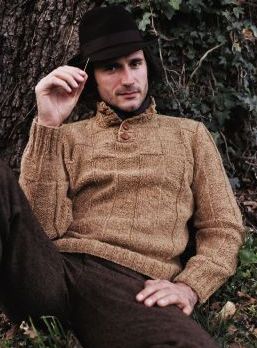
A new sweater for my husband is in the works.  He’s settled on Beau from Rowan, which will be perfect for him.  (Ignore the idiotic pose there–Scott will never, ever pose like that, or wear a hat like that, or, well, be the sort of goofball Rowan seems to find perfect in male models.)  The suggested yarn isn’t going to work though, because it’s too scratchy.  So I’ve been polling the knitters and searching for alternatives, and now we just need to find the correct combination of weight, color, and texture.  Ooh, and buttons.  Buttons will be fun.

I’ve also frogged the ground-up-clown socks, rescued the needles, and started a new pair of knee socks out of a much prettier trekking colorway.  It’s the marled blues, and I heart it.  I will be knitting these particular socks for the rest of my life, of course, but I will be knitting them happily.   Not true for the previous denizens of said sock needles.

And, I’ve jumped on the bandwagon and started a mitred-square afghan using leftover sock yarns.  I will remain firm, and will not buy yarn to add to this project.  I will only use scraps and cast-offs.  I will, of course, use the ground-up-clown, because it won’t be much fun to use for socks once I’ve cut out the offending sections.

Finally, in the spirit of new years and beginnings and birthday wishes and all of that pap, I’ve made a bit of a deal with some friends, and I’m going to throw it out to you all too.  I’m a writer, but I don’t write enough and I certainly don’t pursue publication as I should.  It’s embarrassing to finish a story-telling or bardic performance and have to say no to people who ask for books or CDs because I just haven’t honestly tried to make a CD or get a book published.  I’ve had to turn would-be patrons away a few times now, and it’s downright ridiculous.  I’ve only submitted one piece for publication in the last year and a half or so, and while I certainly was pleased when it was published, well, that’s a crappy rate of submission.  I let everything else come before my writing, and I have for ages.  No more.

Right, so, I told a funny story, a story of a first of sorts, to some lovely people late Saturday night at Rhinebeck, and I think and they thought it was pretty funny.  They could have just liked the cake and the wine . . . . Jayme, Janet, and I got to talking about writing the next day, and I made all sorts of ridiculous excuses, caught myself, and asked them to give me crap if I don’t write something down.  And then I asked Rachel to give me crap if I don’t write.  So I’m going to write down that little story and try to get it published.  If I don’t, please call me on it.  Shame is a powerful and effective tool against me.  It really is.  And I’m inviting you to use it.   Just this once.

Filed in blather,knitting | 7 responses so far

« Newer Entries - Older Entries »