Setting Up House

Posted by on Tuesday, February 28th, 2006

I mentioned before that my first introduction to Berryman was Dream Song #14. It remains one of my favorite poems ever written, and knocks around in my brain the way “You do not do, you do not do / Anymore black shoe” and I grow old…I grow old…/ I shall wear the bottoms of my trousers rolled have taken up permanent residence there. Some poems you love, but some poems set up house. There are a number of Dream Songs that live in the back of my brain, namely, numbers 1, 4, 14, 29 and 76.

One of the reasons I like The Dream Songs so much is because Henry is such an outsider. When it comes to academia, he’s an insider who feels like an outsider. When it comes to life, there is always that feeling that Henry is on the outside looking in. As a generally shy, usually awkward person, as a person who has/had a love/hate relationship with academia, I can relate on a, um, decidedly less depressing level.

In the first Dream Song, we are introduced to this theme early on: “All the world like a woolen lover / once did seem on Henry’s side. / Then came a departure.” Thus the loneliness of the Dream Songs begins. Henry’s one friend to talk to is putting on a minstrel show; that is to say, even his friend is not who he says he is, and furthermore, acts more of a comedian to Henry’s straight man. This friend has no name, no face, and is performing in a show, of which it is not clear that Henry is aware he’s part.

So much of The Dream Songs is just, well, heartbreaking. Soul crushing. Devastating.

29
There sat down, once, a thing on Henry’s heart
só heavy, if he had a hundred years
& more, & weeping, sleepless, in all them time
Henry could not make good.
Starts again always in Henry’s ears
the little cough somewhere, a chime.

And there is another thing he has in mind
like a grave Sienese face a thousand years
would fail to blur the still profiled reproach of. Ghastly,
with open eyes, he attends, blind.
All the bells say: too late. This is not for tears;
thinking.

But never did Henry, as he thought he did,
end anyone and hacks her body up
and hide the pieces, where they may be found.
He knows: he went over everyone, & nobody’s missing.
Often he reckons, in the dawn, them up.
Nobody is ever missing.

(This is the poem, by the way, that I compared to “Smell of Blood” back when we were discussing Nuala.) This is the Saddest Poem Ever Written. I can’t read it without crying, the way I can’t watch Audrey Hepburn throw Cat out of the cab into the rain without crying. (Okay, to be honest, #29 just makes me sad and a little teary-eyed, but the wet cat turns me into a blubbering idiot. Yeah. I’m highbrow.) There is such a loneliness here. The poem echoes like solitary confinement, brooding over the punishments he feels he deserves for a crime he never committed. The last line, “Nobody is ever missing,” feels only partially true. Because what is missing is some sort of connection between Henry and the people around him. The imagined crime seems to be some sort of rationalization for his loneliness. He deserves to be alone because he feels he has done something terrible. As with #4 when Henry says, “There ought to be a law against Henry,” his friend replies, “There is.” There is a deep shame that surfaces throughout the Dream Songs. It is, as in #29, excruciating at times.

You know what it is–and this just occurred to me–I like grand gestures in poetry.* I like wildly dramatic statements, big bold metaphors, bold use of rhythm or repetition. The poems I quoted in the first paragraph? Big, ambitious poems. Poems that use heavy repetition, intense rhythm, and metaphors that threaten to knock you silly. Big, bullying metaphors. Poems that can hardly keep their heads above water what with the big heavy grandiosity sitting on their shoulders. I guess I’m not big on the subtlety. And there’s little that’s subtle about Berryman. Henry’s a sad, sad man. And he’s fucked up and fighting and lusting and complaining. He’s a mess. He slaps his metaphors around so fast that the grammar doesn’t even land right. And goddamn, but I love him for it.

I’m not sure I’ve even completed a thought yet, but to quote Ani, “I’ve got shit to do” and American Idol to watch.

——-
*This train of thought brought to you by Denis Johnson, whose poem “Enough” collected in <em>Incognito Lounge</em>, begins with the lines, “The terminal flopped out / around us like a dirty hanky…” While I admit that the simile makes very little sense, I’ve always admired it, and appreciate Johnson for the spectacular…balls…with which he writes. (I’d been toying with the idea of choosing this book next, but still somewhat undecided….)

Filed in Eating Poetry | No responses yet
More Interview Excerpts

Posted by on Tuesday, February 28th, 2006

Originally posted by Rachel


There’s a real post in progress, really, but first, I promised some more interview excerpts with Berryman.

From “An Interview with John Berryman,” John Plotz, originally published in The Harvard Advocate 103,  no. 1, reprinted in Berryman’s Understanding: Reflections of the Poetry of John Berryman, edited by Harry Thomas, Northeastern University Press, 1988.

INTERVIEWER:  Is there any ulterior structure to The Dream Songs?

Ah–you mean, somebody can get to be an associate professor or an assistant professor by finding it out? Mr. Plotz, there is none.  Il n’y en a pas! There’s not a trace of it. Some of the Songs are in alphabetical order; but, mostly, they just belong to areas of hope and fear that Henry is going through at a given time. That’s how I worked them out.

INTERVIEWER:  So, in fact, the book has no plot?

Those are fighting words. It has a plot. Its plot is the personality of Henry as he moves on in the world.

INTERVIEWER:  Why is Henry called “Mr. Bones”?

There’s a minstrel show thing of Mr. Bones and the interlocutor. There’s a wonderful remark, which I meant to use as an epigraph, but I never got around to it. “We were all end-men,” Plotz–that’s what it says–“We were all end-men.”

INTERVIEWER: Who said that?

One of the great minstrels. Isn’t that adorable? “We were all end-men, and interlocutors.” I wanted someone for Henry to talk to, so I took up another minstrel, the interlocutor, and made him a friend of my friend Henry. He is never named; I know his name, but the critics haven’t caught on yet. Sooner or later some assistant professor will become an associate professor by learning the name of Henry’s friend.

<br>
From “The Art of Poetry: An Interview with John Berryman,” Peter Stitt, originally published in The Paris Review 53, reprinted in Berryman’s Understanding: Reflections of the Poetry of John Berryman, edited by Harry Thomas, Northeastern University Press, 1988.

INTERVIEWER: You, along with Lowell, Sylvia Plath, and several others, have been called a confessional poet. How do you react to that label?

With rage and contempt! Next question.

INTERVIEWER: Are the sonnets confessional?

Well, they’re about her and me. I don’t know. The word doesn’t mean anything. I understand the confessional to be a place where you go and talk with a priest. I personally haven’t been to confession since I was twelve years old.

Filed in Eating Poetry | No responses yet
Gold Medal

Posted by on Tuesday, February 28th, 2006

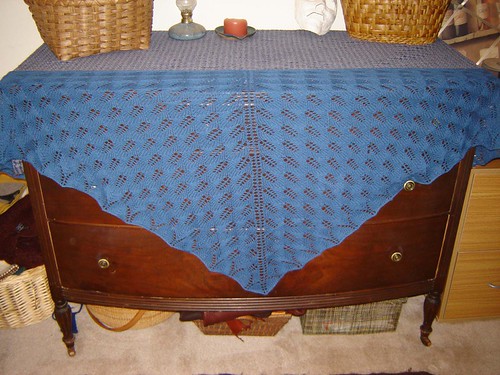
Kiri, in Elann Baby Cashmere, Tapestry Blue.  Knit on US size 7 needles Pony Rosewoods, Addi Naturas, and Susan Bates Quicksilver needles in that order.  More or less.  The Quicksilvers kept driving me nuts because I hate the metal-on-metal sound, and the Naturas kept driving me nuts because that little divot at the join was grabbing the yarn like mad.  I wish I could always and only knit on bone or antler needles.  If anyone can arrange that, I would be eternally grateful.

As I mentioned several times during the Knitting Olympics, I think Kiri is a great pattern.  It’s a wonderful first shawl project for we beginning lace knitters.  It was challenging to complete the entire project on time, but it was fun the whole time.  I loved to watch the leaves form as I knit,


(tree-hugger nirvana, that) and I was generally able to catch my mistakes within a few stitches of making them.  I love the shawl, and I’ve received many compliments on it already.  I originally thought I’d have no practical use for it, but I ended up wearing it to the American Craft Council show in Baltimore, and I was loath to remove it when the room got hot. 

My only gripe is with my own affect on the edging.  I don’t know if it’s the yarn or my bind-off or my blocking jobs (once after washing, the other with steam), but I can’t get a nice clear scallop to hold.  I think I was a bit too gentle the first time, but I really pulled the points out when I steam blocked.  Did I not steam enough?  Is the alpaca content in the yarn (60%) too high to yield a crisply-blocked edge?  Am I just too much of a hippie to torture the yarn into submission?  Inquiring Laneas (ok, just the one Lanea) want to know!? 

Filed in knitting | 8 responses so far

Hearing Berryman

Posted by on Friday, February 24th, 2006

I haven’t fallen off the planet or anything, but the Knitting Olympics and trading offices with my husband have been monopolizing (biopolizing?) my time.  Done and done. I am normally the Queen of Class Participation.  I’ll try to be a better student from here on out.

I finally got comfortable enough with my own version of Berryman’s voice to listen to his actual voice, which Rachel linked to a while back.  Wowza!  First, how can I not love a person whose response to applause is "Knock it off, ladies and gentlemen."  I love the combination of self-deprecating humor and true annoyance at adulation.  I agree that he sounds drunk or a bit sedated.  It makes sense.  It’s uncomfortable to listen to.  It should be, I think, all things considered.

Berryman: "Now, I don’t give a damn about the Dreamsongs.  I’ve lost interest in them.  But other people are interested in them, so I will read some.  But it’s the new book that has also begun to lose my interest.   The Dreamsongs are about a man named Henry.  Henry is a white American in early middle age.  His age changes in the poem, which took me 13 years to write, from 41 to 51.  And he has many adventures and has been married at least three times and is often a bachelor in between the marriages.  And he has suffered an irreversible loss.  The work is called witty by people here and abroad, but it’s not fundamentally humorous.  It’s dark." 

Just.  Wow.  Writers who are trying to sell books don’t tell you their most famous work doesn’t interest them anymore, and that they’re losing interest in their current projects, true or no.  Berryman has a painful disinterest in his work and his life, but it’s welded to huge bravery. 

Listening to Berryman read Dreamsong #1 almost made me weep.  I know these poems are largely autobiographical.  Hearing the sadness of that poem is crushing, even though I would read the words differently if they were mine.  At this point, the final two lines are among my favorite lines in English.  The upswing in his tone as he reads them leaves a gaping wound.  I don’t see how Henry survived, either, knowing that loneliness is our only payment for our life’s work.  Thankfully, I’ve got the  They Might Be Giants cheery absurdist view of our doom, and it comes with a jangly soundtrack (Don’t Let’s Start–everybody dies frustrated and sad, and that is beautiful).

Yeesh.  Let’s read some really cheery e.e. cummings next, mmmkay?

Four is much less right in the reading, until he’s discussing spumoni, and then I believe he still has a bit of lust left.  Just a bit.  I’m glad he carries the humor through Dreamsong 14, and the cracks about Harpers are wonderful.  The pause between:
and moreover my mother told me as a boy
(repeatedly) ‘Ever to confess you’re bored
means you have no

Inner Resources.’

and
I conclude now I have no
inner resources, because I am heavy bored.

shows true comic timing.  I think Berryman decided to be Henry’s friend rather than Henry, here.  I can’t say I blame him. 

Berryman starts scaring me again in #76.  Which is odd, since, you know, I clearly can’t take away his depression or suicidal urges.  I can’t imagine how uncomfortable the audience must have been, hearing this:
Henry’s Confession

Nothin very bad happen to me lately.
How you explain that? "I explain that, Mr Bones,
terms o’ your bafflin odd sobriety.
Sober as man can get, no girls, no telephones,
what could happen bad to Mr Bones?
"If life is a handkerchief sandwich,

in a modesty of death I join my father
who dared so long agone leave me.
A bullet on a concrete stoop
close by a smothering southern sea
spreadeagled on an island, by my knee.
"You is from hunger, Mr Bones,

I offers you this handkerchief, now set
your left foot by my right foot,
shoulder to shoulder, all that jazz,
arm in arm, by the beautiful sea,
hum a little, Mr Bones.
"I saw nobody coming, so I went instead.

So why are we so drawn to pain in writing?  What is it that allows us to look so unabashedly at our suicidal poets?   Ok, I’m going back to some jangly chipper goodness from John and John to make a happier start to my weekend.  Unlike Henry, I’m not looking forward to a posthumous opus about me appearing anytime soon.  I’ve want to extend this gig for as long as I can. 

Filed in Eating Poetry | No responses yet
Time to learn the Welsh National Anthem, everybody

Posted by on Thursday, February 23rd, 2006

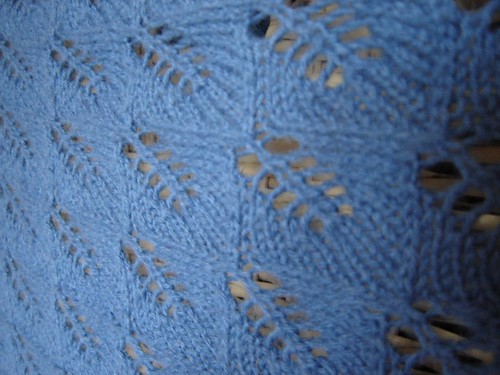
Kiri is knitted, washed, and pinned out on a sheet in a pet-less room.  Tomorrow morning, I expect some good palatal double Ls and some fine clear diphthongs from all of you after I weave in the ends.  Halla-fricking-Lleu-Llaw-Gyffes-yeah.

And, as if that weren’t good enough, I have reached near-completion in my new studio.  I have to pick a paint color, buy an Ott light with one of those 40% off AC Moore coupons, and hang some pictures.  Would you like a tour?

If you stand in the door and look to your left, you’ll see the antique dresser where my garment fabrics and beading supplies live.   The bedroom in my parent’s new house is conveniently lacking in room for this beauty, so she moved here.  Underneath are stashed baskets that hold my hand-sewing projects, deerskin, and paper.

And then a desk in the back left corner.  Well, a farm table covered in electronics, and a very uncomfortable but exceedingly beautiful green antique chair.  I have two, for twice the butt-numbing fun!

Continuing on . . . some shelves with office-y books and supplies on the left and knitting books on the right.  The basket in between holds completed quilt blocks and the backing fabric;

and the hanging baskets hold buttons.

Yes, the antler buttons must live in the antler basket.  On the nose is not always trite.  Some things thrive together.  I’m hoping they’ll breed in there.  The other two neato baskets, built around some antique calipers and some antique smith’s nippers, hold shell and metal buttons, respectively.

Next: the sewing table.   Complete with flowers from Scott.  The big basket on the floor is the one, the only, the original  . . .

Crazy Lanea’s.  It holds finished garments seeking homes.  It’s nearly empty at the moment–one baby sling, one scarf, one knitted ruana, a couple of woven belts, two or three tunics, a Mongolian vest, and a half-dozen pairs of pants.  Good thing the sweat-shop studio is back in action–Lanea needs a new pair of Ewes!

On the right wall, a basket of things waiting for machine-sewing, quilting and sewing books and patterns, my inkle loom, quilting scraps sorted by color, and a basket of spinning fiber.

Finally, the wall to the right of the door holds the big stash-storage system:

Hubba hubba.  Yarn.  Fabric.  All sorted by color and fiber.  Handmade baskets and pottery on top.  A girl could swoon.  The wall behind should turn marine blue within a few months.  And then I may never leave.

Filed in knitting | 13 responses so far

Commercial break

Posted by on Wednesday, February 15th, 2006

Can’t talk: watching curling!

I am writing during commercial breaks.  Running up and down the steps over and over again so you, Gentle Reader, don’t think I’ve fallen off the planet.  Really, I’ve fallen into a long-awaited winter.  An Olympic Winter, no less.  I’m absolutely chuffed. 

It snowed!  It finally snowed!

Kayo needs snow.  And sticks.

And the fetching thereof:

Followed by the peaceful contemplation:

And finally, the willful destruction of the beloved object:

Adopting a snow dog forced me to expand my concept of snowy splendor.  I liked the snow when it was pristine.  I loved it when it was churned by hundreds of Kayo prints.  It’s mostly melted now.  I hope it snows twice as hard this week.  Fingers crossed. 

In addition to the snowing, we have Olympic knitting in process.  I swatched last week:

Notice the squared-off end?  I swatched and then frogged and started over, just like the good little participant I am.  Unfortunately, that stupid job of mine kept me from starting until 5:00 pm on Friday, dag nabbit.  But I love Kiri, and the yarn I’m using:

The shawl is 22 inches from point to center now.  I hope I can finish on time.

The biggest obstacle is my other feat.  Like some rare Olympians, I am a multi-sport maniac.  In addition to knitting, I am also  switching office space with my husband.  Who is the best man in the world, you know.  He offered and offered to trade spaces, and I asked over and over again to see if he was sure, and I finally cracked.  I now have a studio more than twice the size of the one I had on Thursday.  But she is disheveled:

Ok, stop looking.  It’s embarrassing.

And it’s driving me mad.  Knitting Olympics plus new studio equals Crazier-than-Usual-Lanea.  Don’t mind the barking.  Things are a bit better than this now, but my progress was slowed when I had the audacity to plug in a vacuum on Sunday and blew out half of the power in the house.  Suffice it to say, we really did buy this place from idiots.  A very nice electrician from Pittsburgh (Yay Steelers) made everything (electrical) right again Monday afternoon, and explained how much we’d need to replace to make sure everything stayed operative.  Anyway, I lack the necessary storage to make the office right, so there is another Ikea death-march in my future.  Until then, sate yourself with this yarn porn:

Nice, eh?  You wanna see up close, don’t you?  You naughty knitter–I know what you like.

A whole cubic foot of beautiful wool, some of it hand-painted, some of it discontinued, all of it right there.  So much yarn that it can be turned over my head without risk of any of it escaping the basket, like a well-whipped mess of egg whites.  Ok, that would not be a hot analogy to most people, would it?  Anyway, you want more?  I’ve got more:

A bouquet of hand-painted and hand-spun beauties.  Classy but surprisingly attainable, right there at my finger-tips.  And handmade bobbins, all sitting on a  hand-woven bit of heaven.  I know you want them.  They know you want them.  Get in line, sister.   Cuz those girls are all mine. 

Oh, I know.  You want to see what’s in the other basket, don’t you.  The shy one.  The tease.  Fine, but that’s it.  From here on out, sweetie, you’ve gotta pay.


More hand-paints, and some alpaca blends, and all sorts of other delicious goodies.  Mmmmmmm mmmmmmm MMMMMMM.  I need me some more of that kinda love.   

Back to Kiri.  And curling.  And another Ikea death march.

Filed in blather,knitting | 7 responses so far

Austerlitz

Posted by on Monday, February 6th, 2006

Austerlitz by W.G. Sebald.  There’s a good chance I picked the wrong time to read this book.  Reading about the holocaust and its affects while experiencing any sort of trauma is dicey.  Reading a book almost entirely without paragraph breaks that is also about the holocaust is downright ill-advised.  Nevertheless, I loved the book, but I read it slowly and then thought about it for a good while before reviewing it. 

As usual, I kept wondering how much better this book was in the original German.  I get the sense that the translator did well in communicating the clipped dryness of an aging man trying to hide his anguish as he recounts his familial tragedy.  It’s a story about a man who was once a boy whose parents and home were snatched from him by genocidal bureaucrats.  That’s really all that needs be said.

Filed in Books | 2 responses so far

A blogger’s (silent) poetry reading

Posted by on Thursday, February 2nd, 2006

This is one of my favorite poems.  It rattles about in my skull always, speaking to my love of the mountain chain that runs through Appalachia, Britain, and Ireland. 

Heritage (1935)
by James Still

I shall not leave these prisoning hills
Though they topple their barren heads to level earth
And the forests slide uprooted out of the sky.
Though the waters of Troublesome, of Trace Fork,
Of Sand Lick rise in a single body to glean the valleys,
To drown lush pennyroyal, to unravel rail fences;
Though the sun-ball breaks the ridges into dust
And burns its strength into the blistered rock
I cannot leave. I cannot go away.

Being of these hills, being one with the fox
Stealing into the shadows, one with the new-born foal,
The lumbering ox drawing green beech logs to mill,
One with the destined feet of man climbing and descending,
And one with death rising to bloom again, I cannot go.
Being of these hills I cannot pass beyond.

James Still is one of the unsung greats of American poetry.  He died  a couple of years ago after a lifetime of teaching and writing in the hills of Kentucky. 

I can’t tell you how happy it makes me to know that so many other people are thinking of Brigid and Imbolc now.  It’s my Mom’s birthday, and it’s time to head down to John the Ferrier’s for a weekend of work and creativity and fellowship. 

Filed in Books | No responses yet

So far

Posted by on Wednesday, February 1st, 2006

So far, Berryman is all about rhythm for me.  And what’s weird is that the rhythm I find in the poems isn’t matching the rhythm Berryman uses in his readings.  So I’m going to ignore the poet’s literal voice for now, until I get more comfortable.  I’ve run across a number of poets whose readings rattle me because their physical voice seems so detached from what i hear in my head as I read.  Berryman is doing that to me. 

As one who reads for pleasure, I get to indulge all sorts of loves and opinions my professors tried to train out of me.  Hawwhawwhaww–you can’t stop me from liking things just because I do, so there.  And I’ve got to say, Berryman picked the right way to open if he wants to win me over.  Because it’s all about ME.  Ok, of course it’s not about me, but the first dream-song is very pleasing to me.  Both the woolen lover simile and the sycamore pleased me, tree-hugging wool-head that I am.  And I’m loving the switch from post-modern jazz-inspired boom-chicking along the lines to this gorgeous bit of lyric:
Hard on the land wears the strong sea
and empty grows every bed.

This is a man with tools and technique.  I expected the jazz.  I didn’t expect the ballad.

Dreamsong 4 got me good.  I love men who really love womanliness.  It’s that simple.  And here we have a lusty man admitting that his desires go too far.  The closing beats make it:
Where did it all go wrong? There ought to be a law against Henry
–Mr Bones: there is.

Nuff said.

And then to #13.  The lyricism and rhythm are again lovely, of course, but I also appreciate the vulnerability.  This breaking down of bravado. 
God bless Henry.  He lived like a rat,
with a thatch of hair on his head
in the beginning.
Henry was not a coward.  Much.
He never deserted anything; instead
he stuck, when things like pity were thinning.

So may be Henry was a human being.
Maybe he was.  A cornered rat, hated by God.  Berryman released this knowing that his audience would assume he was Henry.  He was Henry.  I guess I find that kind of nakedness before an audience of any kind brave, and risky. 

Filed in Eating Poetry | No responses yet
Answers

Posted by on Monday, January 30th, 2006

Juno asked if I like brown.  You know what kind of brown I like, Juno?
I like Boyne river-reed brown

And mini-horde of amber brown

And oak griffin brown

And ladder-back chair brown

And elk, doe, and buck-skin brown

And birdseye maple brown

And birchbark brown

And rust brown

But I love Kayo brown above all else.

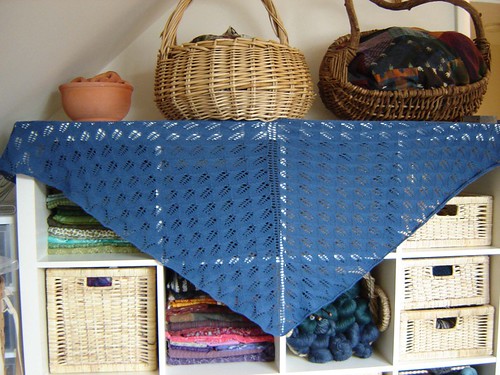
So imagine my joy at finding Shetland cashmere/silk laceweight in Kayo-brown on my doorstep.  Thank you so much.  Kayo thanks you too. 

This will become Kiri, if all goes as planned.  I may not be able to pull off a medal in the Knitting Olympics, but I sure am going to try. 

I will join Team Wales.  Because I know more about Wales than is ultimately safe to know.  I feel it is my duty to serve. And I may need to get on the liquid-refreshment teams too.  Yes yes.  Must swatch. 

Filed in knitting | 5 responses so far

« Newer Entries - Older Entries »