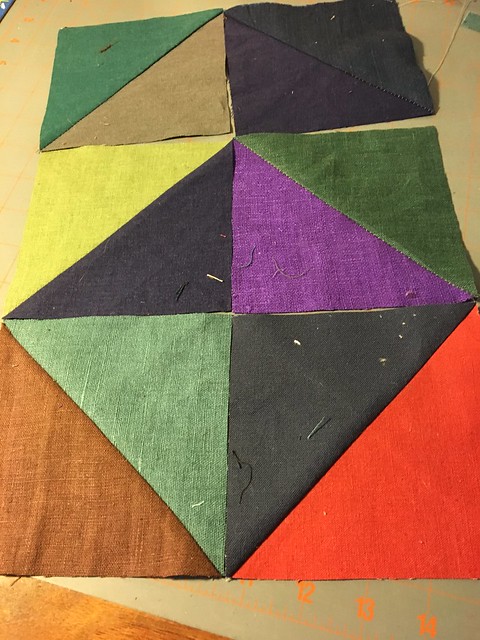
Lightning Round

Posted by on Thursday, January 31st, 2019

I’ve been working away on dozens of little projects, and then a million things happened at once.  I’m still processing. 
I wrote a new song, and I love it.  It started out on a very different path than it eventually carved for itself.  
I went to an event most of my closest friends don’t attend. And then, strangely, many of them were there with me. 
I competed in arguably the most prestigious regional Bardic competition and a friend and I won together.  We began plotting a year of shenanigans. 
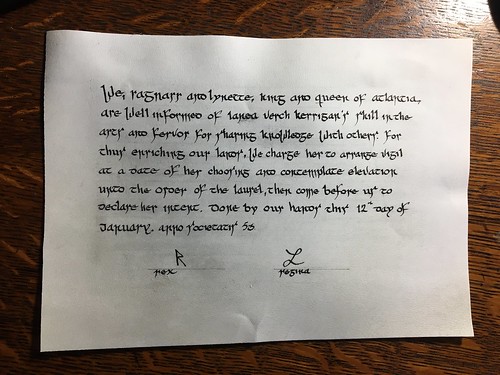
And then I was given a writ to contemplate joining the Order of the Laurel at Gulf Wars in March. My dear friend Sinn did the calligraphy on beautiful vellum.  

I never thought I would wind up in this position.  I’ve operated on very strange paths throughout my time in the SCA, and while I haven’t actively spurned notice, I also haven’t sought it often.  I want to sing and research and study and teach and make things, and I want to spend time with my friends and help out when I can. 

So now I’m rushing to finish piles of projects by early March so We can go throw a giant party and I can take on a major new volunteer job.  Weird.  It’s weird.  

More importantly, it’s astoundingly touching.  An invitation to join this Order came because many many people spoke on my behalf, took notes on my work and spoke in my favor in hushed discussions.  Once it was clear that it was happening, my friends came together to witness the announcement and speak publicly on my behalf.  And then offers to assist in the next steps flooded in.  In just a few days I was given completely tangible proof that people care about this weird work I do, and they love my art, and they think I am a good teacher and can help steer the arts community in a good direction.  I’m flabbergasted. Truly. 

The song, which will continue to grow, is coming.   


Filed in bardic,blather,Celtic | No responses yet

Irish postcards

Posted by on Sunday, November 4th, 2018

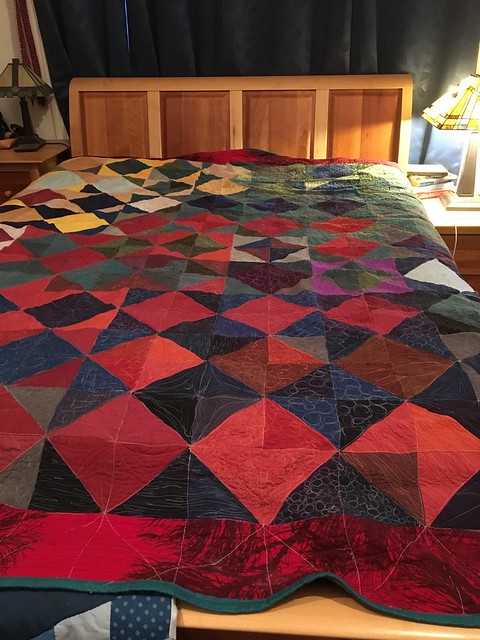
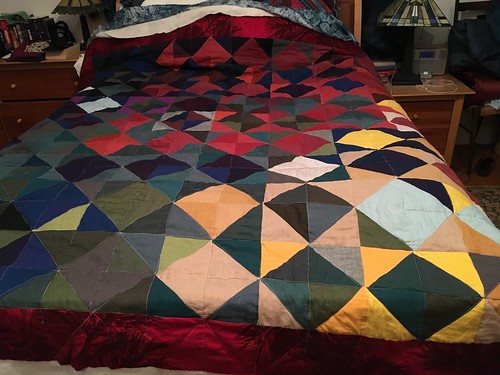
My linen quilt is finished and wound up being a great project for learning.

Because I worked primarily with linen garment scraps, my color selection was decidedly different from the quilt I based this project on. I pieced via serger, which is guaranteed to be a pain. It also leads to a fair amount of seam bulk, which is challenging to quilt. I’m happy with the results in spite of the challenges.

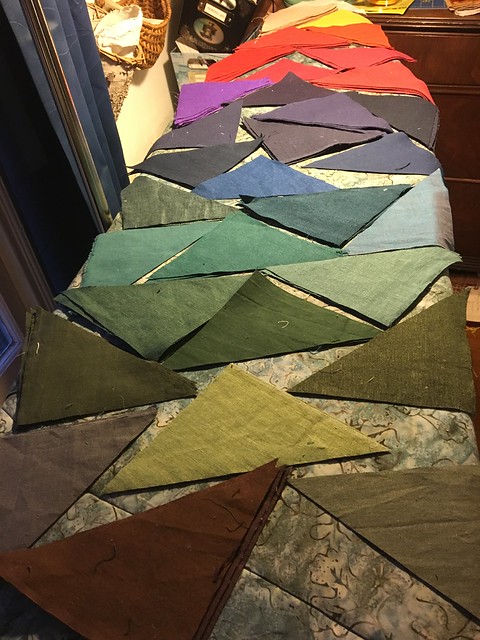
I opted to lay the squares out in a squared off color wheel configuration.  I like how much movement it has, even with such simple piecing and a relatively broad color palette.  

Once the top was pieced, I added a wide border of a lovely Marimekko red print and a green linen Marimekko backing, both of which I scored at a Crate and Barrel outlet sale a few years ago. Then I pin-basted it and used a walking foot to quilt around the blocks in a grid.  

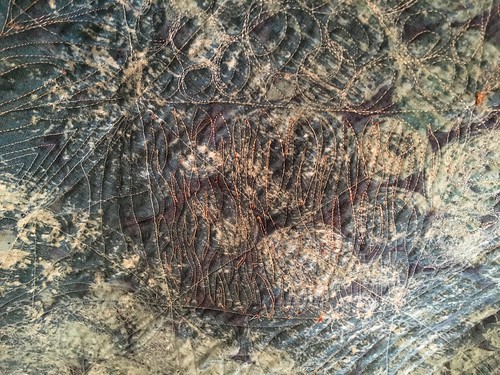
That first round of quilting convinced me that quilting the whole thing with a walking foot in relatively straight line designs was going to be tedious and uncomfortable, since it would mean hefting so much weight so many times: it’s a queen sized quilt, and garment linen is significantly heavier than quilting cottons.  So I forced myself to be brave and try free motion quilting on a large scale.  I’ve been hesitant to try it because it doesn’t come naturally to me, and I am far from expert, but the project made me much more comfortable with free motion quilting. I varied patterns and threads throughout the quilt and learned which styles I’m more comfortable with. The finished quilting makes sense with the scrappiness of the top.  I quilted the snot out of some of the sections and left others more open.  

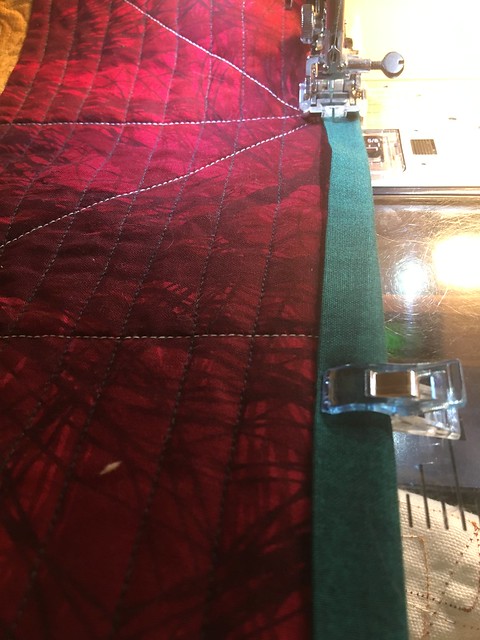
I opted for a gorgeous blue-green shot cotton for a binding–I love it’s play against the red border. 

The finished quilt washed and dried up well, and this guy approves, so I’m calling it a victory.  


Filed in quilting | One response so far

The Saga of this ludicrous coat: an Arts and Sciences entry

Posted by on Sunday, October 14th, 2018

I went to a local SCA event yesterday called “The Wild Hunt.”  They had a pair of A&S competitions, one of which intrigued me. “Best fix” was all about a correction or repair, and this coat fit the bill perfectly.
helm

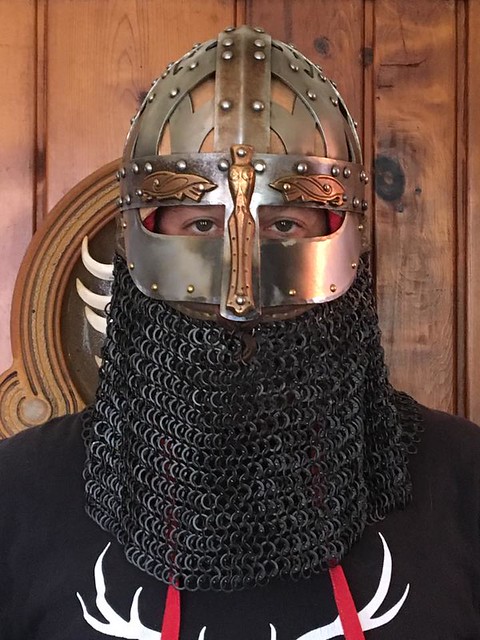
My partner Alherin began using a Valsgärde 6 helmet for tourney fighting in the spring of 2017. The helm is based on a Vendel era boat grave find from Sweden, dating to 660-710 CE 1, and thus later than the material he had previously used to guide decisions about his kit. In general, reproductions of extant early period armor need a great deal of modification to function for SCA combat, and many soldiers or warriors in the ancient and early medieval world had little gear beyond weapons and a helm. Helms like the Valsgärde 6 require the addition of bar grills or some other facial and neck protection, modifications to the size of eye openings, etc. Moreover, the sort of neck, body, leg, arm, and hand armor that functions well for SCA tourney combat was largely developed after the time period he chose for this kit. Alherin cobbled together a kit made up of both modern sports equipment (groin protection, padding, and kydex body armor) and later period items (splinted arms and legs, gauntlets, gorget) that function well and meet SCA safety requirements. Once he had assembled and constructed a new tourney kit, I took on the task of covering the combination of reproduction and modern gear that worked for his fighting style so that he would look as good and as “period” as possible, given the scant evidence of Vendel era armor and textiles available.

Valsgärde 6 has, arguably, the most beautiful helmet of any of the finds in the burial complex. But it has little else2. It is possible that the boat graves were robbed at some point, but whether natural or human intervention is to blame, we had no inhumed garment to use as a basis for this exact helm. I consulted a number of sources and settled on a modified klappenrock to cover his armor and serve as a quasi-heraldic garment so Alherin would be identifiable on the field. The v-neck of such a coat would expose his armor, however, and since we have no doumentable gorget or breast place options to turn to, I decided to use a round neckline with a button attachment instead. Ideally, a wool twill would serve as the primary fabric for a klappenrock, but washabillity, local weather patterns, and Alherin’s own desires took precedence and I used a heavyweight linen tabby instead. I opted to rely on the checkered patchwork of our tribe Preachain as an accent in the gores, along the placket, and on the sleeves. I also opted add embroidery to the back of the coat to please a dear friend3, choosing a design our dear friend Bran painted on one of Alherin’s shields. Knowing that the coat would face a lot of wear, I used a mid-weight pearl cotton for my embroidery fiber and relied on chain stitch for the majority of the work on that back piece.

Before making the coat, I’d studied the history of embroidery for several years and built a class on the subject. I knew what stitches were common in period and what would wear well. I’d done some experimentation with embroidery as a repair method, and I know a number of people who are much better at drawing than I am, so I hoped to convince at least a few of them to sketch designs for me as need required.
coat2
(Photo by Krystal Smith)

When Alherin stepped onto the field in this coat the first few times, I knew that friends would make a game of trying to break the button off in combat (none has succeeded thus far) and that the black and red colors our tribe relies on would fade with washing and the sun. I also knew that embroidery developed out of repair techniques like pattern darning, and was ready to do some repair now and then.
brigid

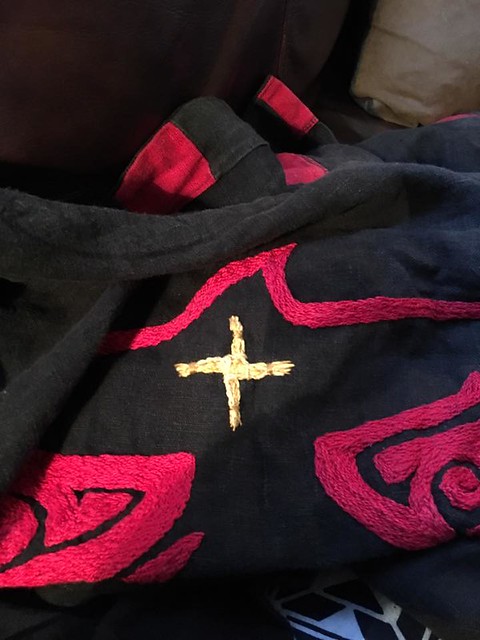
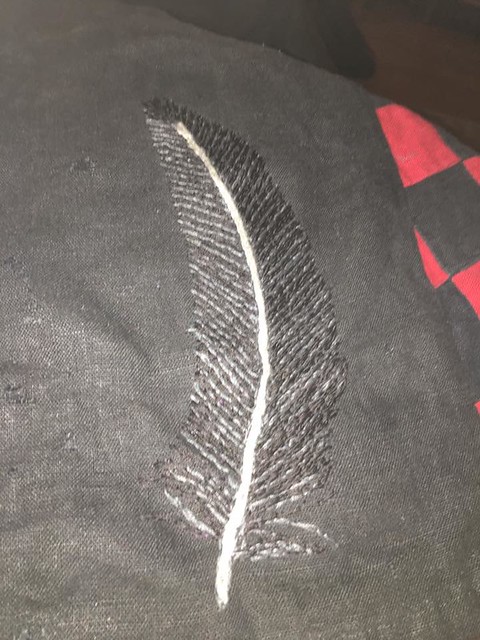
What I did not know was that his new splinted legs would eat the coat from the inside. He wore it for the first time in Spring Crown of 2017 and it took some minor damage, so I made some minor repairs. The repair process hasn’t stopped since. After several repairs were complete, he asked me to add a small Brigid’s Cross to the back piece to symbolize my own heraldry. Ever other stitch I’ve added post-debut has been a decorative repair.
feather

I may have created a monster. I have definitely created an amazing testing ground. The cotton embroidery has fared far better than the silk, as to be expected. At least one of the detergents we’ve used has caused some very sad fading and dulling to the silk repair embroideries.


1 John Ljungkvist, Uppsala University: The development and chronology of the Valsgärde cemetery” table 1a-b. https://www.researchgate.net/publication/278009526_The_development_and_chronology_of_the_Valsgarde_cemetery

2 Maja Wikborg: “The absence of human remains in Valsgärde cemetery. Natural process or ritual phenomena?”

3 Ursus does not want anyone to have solid black, red, or white surcoats because it causes lens flare and color distortion in processing. We listen to Ursus’s guidelines because we adore him.
Filed in Celtic,embroidery,quilting,sewing | One response so far

Competitions

Posted by on Thursday, May 31st, 2018

I’ve never been wild about competitions, particularly Bardic competitions, because of a myriad of reasons.  We all do things differently; we have different styles and time-periods that interest us; we focus more or less on spoken or sung pieces; favor different vocal styles; and on and on and on.  I think I’ve participated in six as an entrant in the 30ish years I’ve been performing in the reenactment community.  There have been competitions where I performed something but asked not to be entered in the formal judging, either because it was a competition to select a champion from a place where I didn’t live or because I was just trying out a brand new thing that wasn’t ready yet.  Here’s the list of competitions I entered that I can call to mind. 

  • Some random event down south when the Torc Song was new: Valerian/Vale/Phil was the one who gathered the prize–a cup full of coins and beads–and the performances took place in the feast hall after dinner was over.  They judged the winner based on the volume of applause. I won.  Valerian was incredbly kind.  I was 17 or 18. Strangers talked to me.  It was dizzying and strange and I wanted to hide but I tried to pretend to be a person.
  • Ice Axe, sometime in the early to mid 1990s.  My armor was new and after I’d completely tanked in the tourney, I was press-ganged into entering it into static A&S on behalf of the folks who helped me make it–B-Zar and Bain–and it won something.  I then had a surreal conversation with the Prince at the time, who awkwardly tried to talk me into doing some ludicrous embroidery for him.  And then there was the bardic competition during the feast.  Warning/Killy the Song was brand new (and had its original tune and evil pacing), and I sang that and won.  And then I was lectured for about an hour by a person who shall remain nameless.  Apparently it was wrong for me to receive two prizes in one day, and I shouldn’t really be entering competitons at all because I wasn’t an apprentice, etc. etc.  My household was on the outs with the regional leadership, and I think I just ended up being the scapegoat for a minute.  And that was when I decided that A&S competitions were maybe not for me.
  • Some random pennsic, Etaine and I went to participate in the Chalk Man bardic competition.  I did well but she nailed it with Rumble/Nine/Song of the Varian Disaster, which was relatively new.  Truly.  Nailed it.  She won.  People wept.  Standing Ovation.  Rending of garments.  Marriage proposals.  WON.  And the organizers gave the prize to their house band because the competition was fixed.  We called them on their trash and they admitted it was fixed but asked us to leave.  Shenanigans ensued.  I’ll leave it at that. I was not impressed. 
  • Gulf Wars 2013? 2012? My dear friend Mistress Gwen from Meridies convinced me to enter a performing arts competition–probably the “open.”  I was hesitant because my voice was trashed, so I performed two spoken pieces: Dan do Emain Macha and Boudicca.  I did well but didn’t win.  A person who stayed at the bead cups by the static displays beat me by a bead.  I was absolutely fine with the results and just needed to get back to camp to make dinner, and suddenly Gwen was nowhere to be found. Lo and behold, she had been carried away by other laurels and they were plotting and scheming.  They ended up deciding to make up another award and brought a delegation of amazing people to our long hall for a command performance and award presentation.  It was one of the proudest, most humbling moments of my life–and yes I realize that is a contradiction. But it was.  I wept, kneeling on the stone floor of the hall with Vashti, who had the audacity to try to kneel to me. The significance of the moment was clear to maybe five people in the room, and it was amazing.  
  • Battle on the Bay 2014: Teleri heard me perform a spoken piece by the fire on Friday and graciously asked me to take part in the storytelling competition on Saturday.  I planned to just listen because I had not prepared anything, but the folks there convinced me to enter.  And I won.  They were very kind, and I felt like a jerk. I felt like I butted in and wasn’t really following the rules. 
  • Ruby Joust 2018: There was a competition for the Baronial Bards.  I am not one, because I don’t live in a Barony and I have refused treatied-in Champion in the past, hoping to help folks encourage newer bards. But my friend Mishee, the bard for Highland Forde, asked me to fill in for her.  So I did, and I won.  And I felt like a jerk who butted in and wasn’t really following the rules. Do you sense a trend?


Here is the rub: I don’t like competitions because they make me feel like a bully.  I have had the sort of education and performance experience that is not common amongst new bards.  I’ve been doing this thing since I was a kid. But I don’t hold many honors within the organization for a variety of reasons.  So people ask me to participate because they want to encourage me or to shine a light on me, but I feel like I don’t belong in that position.  And just writing that makes me feel like I’m spewing out hubris.  But I never, ever want to be the bludgeon that makes another artist feel like they’re failing.

When a normal artist or artisan would have been seeking a Laurel to train with, I was in grad school neck deep in ancient Celtic languages, and my household was so far out of favor in the SCA that Atlantia would have preferred we did not exist at all.  During that period of my life, people from very very far away asked me to apprentice to them, but I knew that rarely went well, so I declined.  Now I am more aware of how my anxiety works and know accepting an apprenticeship would put me in a constant state of stress.  I can’t do that to myself or those close to me–it would be madness.  Madness. 

So I sit here, trying to map a path out of this conundrum.  A friend and I are hosting a Bardic Challenge this weekend–not a competition.  I think we would both like to steer these events in a different, more nurturing direction. I know I’m not alone in this angsty place.  I hope we can all help each other. I don’t think there are any easy answers for me, but I’d like to keep other artists out of this position in which I find myself.

Filed in bardic,blather,Celtic,Music | One response so far

Warping and dressing warp faced band on a Gilmore Big Wave loom

Posted by on Monday, February 19th, 2018

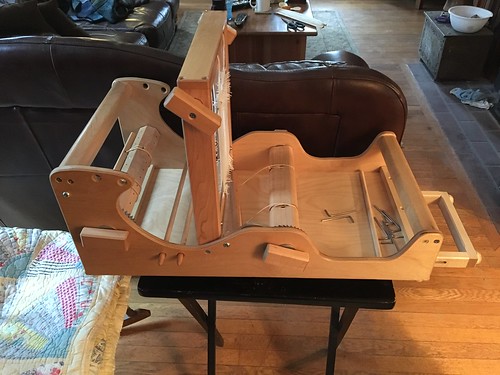
Some friends have asked questions about my favorite loom recently, so I figured an explanatory post was due.  I have a Gilmore Big Wave loom, which I bought several years ago.  

It was significantly more expensive than my previous inkle loom, but in has a number of features that make weaving much easier on my poor achy hands, so I think it was worth every penny.  It is structured much like many floor looms, which makes it stronger than most open-sided inkle looms.  It has a warp beam and a cloth beam, and both are tensioned via those self-braking gears.  It holds beautifully even tention.

Those texsolv heddles seem to last forever, but I have extras if they wear out.  Using this method to change sheds is much, much easier on my hands than any similar loom I’ve worked on in the past.  

This loom obviously isn’t set up for a continuous warp, so I have to warp on a warping board and transfer the warp to the loom to weave.  That allows for a much longer and/or wider warp, so it opens up a lot of possibilities my old loom didn’t offer.  

To begin a project, I gather supplies and review some notes so I can begin plotting a draft.  

I’m making a tone on tone white belt for a friend, so I plot out some color options in the best light available to me, and then design a warp on the board.  Rather than tying the warp, I secure it with some clips.  I am going to transfer it to the loom immediately, so I don’t bother chaining the warp. You can see I have the cross clipped in two spots, just in case.  This warp will make a band that’s about three inches wide. 

Recent

My current habit is to load the warp onto the warp beam and then sley the heddles as if they were a reed, but I am sure you could dress it the opposite way.  

Recent

I’ve pulled the warp off the board and just draped it over the heddle tower, separating out the two arms of the warp cross.  The loom came with two maple dowels to help dress the warp and cloth beams in whichever way you prefer.  It also comes with two lease sticks and has holes drilled to use them or store them–I generally only bother with one for these bands.   

Here, I’ve begun winding the warp onto the warp beam.  The loom also comes with these pins that help keep the warp from spreading out too far on the beam and generally allow you to wind on neatly.  I’m using some scrap cardboard as warp separators.  I wind on carefully, combing the warp with my fingers and attempting to maintain even tension as I go.    

Once the warp beam is dressed, I move to the front of the loom, trim the ends of the warp even, and dress the heddles in whatever pattern I’ve come up with.  When I do these patterned white on white bands, good lighting is vital for this task.  I thread the heddles and tie off using larks head knots, which is pretty standard.  

And then I weave until I get too close to the end of the warp for things to work happily.  

Recent

Filed in Celtic,tutorials,weaving | No responses yet

Linen postcard scrap quilt

Posted by on Saturday, December 30th, 2017

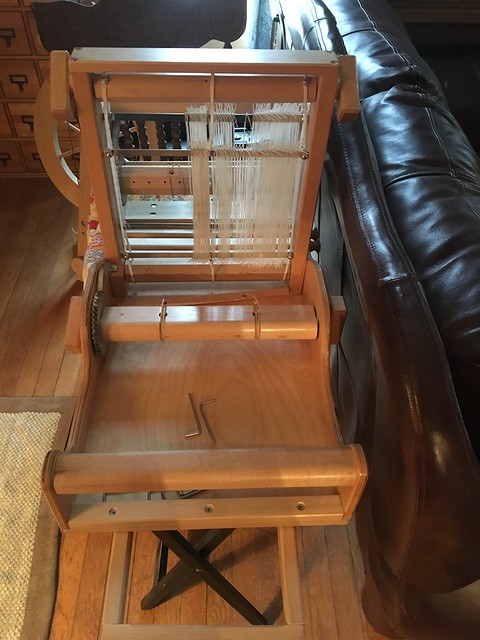
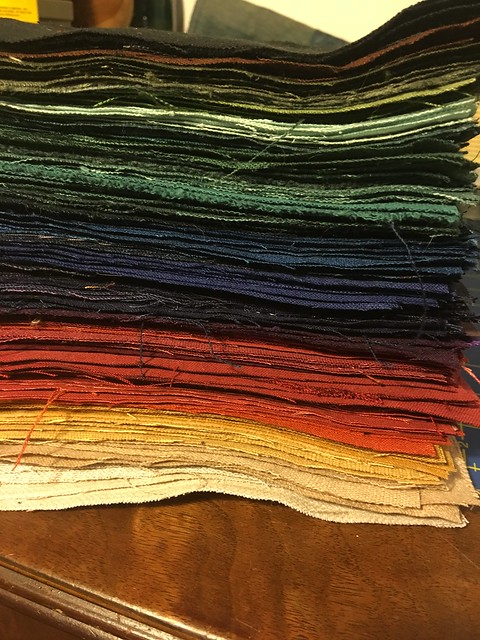
I came across Postcards from Sweden a few years ago, and loved it, and promptly forgot about it.  But then a friend made one, and I gave some thought to the ludicrous piles of linen scraps in my studio, and jumped in.  I will end up with a different palette, because my scraps tend to be darker or sadder than the colors in the original, but I can accept that. I also reached out to friends to see if they had scraps they wanted to part with, and a couple of people were very generous.  I have enough to piece the top without cutting into yardage. 

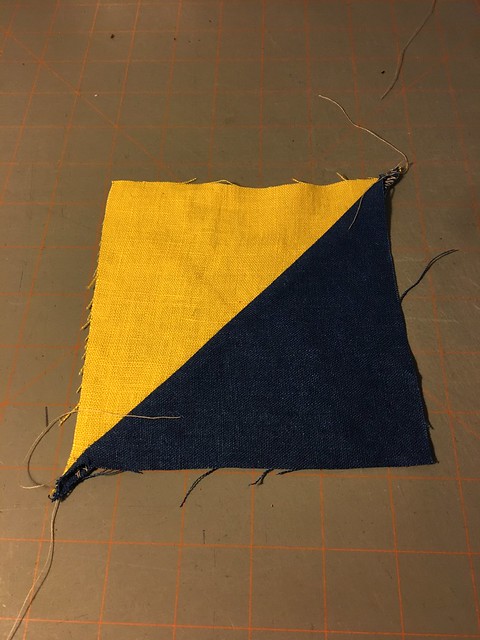
I opted to start with 6″ squares and cut those into half-square triangles, knowing I’d wind up with much smaller blocks once seam allowances and the difficulties of working with linen came into play. 

Using linen for quilts requires a lot of seam finishing, so I tend to piece with my serger to keep the whole thing from disintegrating.  I build in big seam allowances as well, and try to make up for an increased risk of biasing and stretching when I use garment fabrics.  You can see that the serged seam is larger than the standard scant 1/4 inch most quilters use when piecing.  That is all damage control, so I work with it.  As I piece and press, I  am careful not to stretch that biased edge I’m joining.  Linen quilts call for lots of pressing, of course, so I tend to save them for the winter when my studio is otherwise cold.  I do sometimes also starch or use some other sort of pressing spray to try to make up for the stretch and give of garment fabrics.

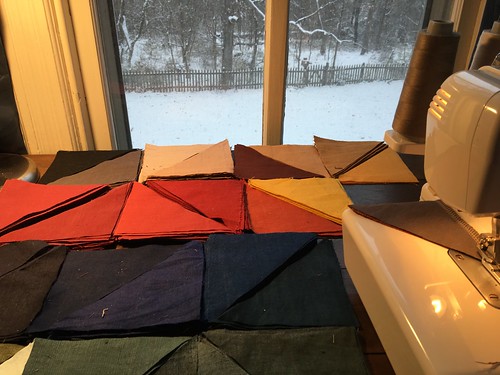
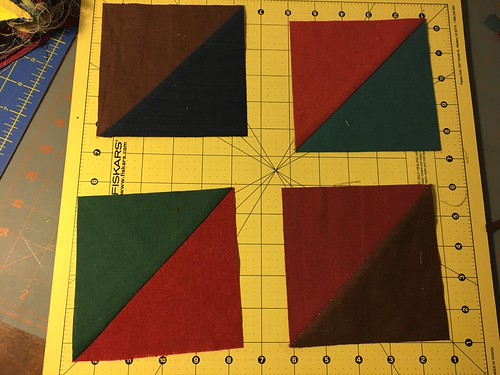
Once I had the fabrics all cut, I set up the stacks and did my best to select pairings randomly.  I had to coerce myself to put some colors together that I normally wouldn’t. 

And then, the trimming.  I kid you not about linen’s tricksie ways.  That is a relatively well pieced block, but the looser weave, the biased edges, and the serged seam all come together to cause some oddities.  

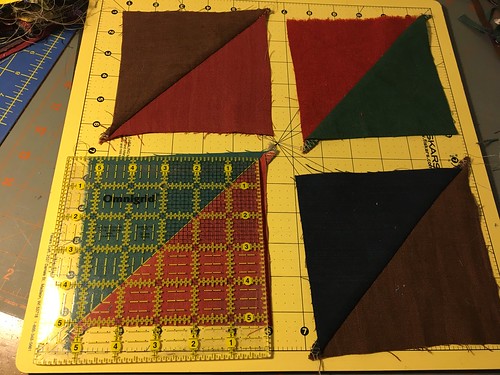
Aggressive trimming is necessary.  I opt to do most things as if I’m on a production line, so I turned to a good ruler with a 45 degree mark and a rotating mat.  I’m trimming batches of four at a time.  If I didn’t plan to start joining blocks soon, I would wait on this.  Trimming is taking off those chains of stitches that help make serged seams last, so the trimmed squares are fragile. 

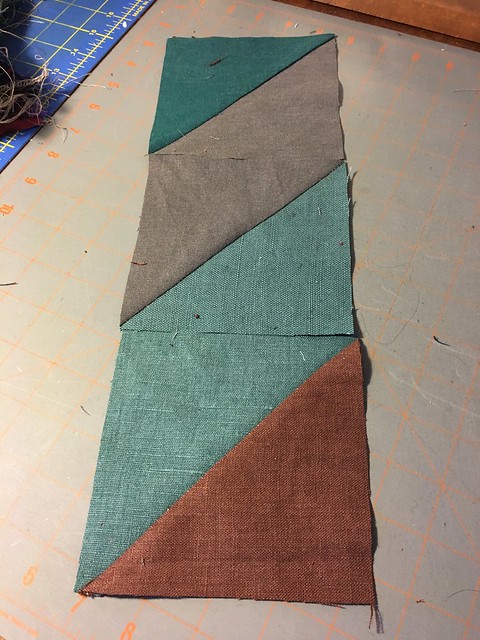
Now, to play with layout options.  I still need to piece 100 or so squares, but I want time to mull over setting in the meantime.  I have a lot of deep blues and reds, so I can rely on them for structure if I want it, or I can fight that urge and lean on improvisation for movement.  I’m not liking diagonal striping. 

But this could work:

I will likely haul out the design wall. 

Filed in quilting | No responses yet

You call yourselves Bards?

Posted by on Monday, October 23rd, 2017

This was my challenge for the Celtic component of the Bardic Quest at War of the Wings, 2017.  Boasts have a particular prominence in Celtic mythology: the most famous is the Song of Amergin, but the boasts in Mac Datho’s Pig are also notable. 

Audio version

You call yourselves Bards? That word is mine–
My Mother Tongue gave it breath.
My mouth its home.
My lungs its fuel.
My eyes its guide.
My hands its weapons.
My head its hearth.
Call me Fili, Ollam,
And know what heights I reach.
I speak the féth fíada to wrap my kin in mist,
Then call up War itself
To tear my foes asunder.
I tangle my enemy’s bowels
And rob sleep from his home with a quip.
I pull tears from your eyes or
Laughter from your belly on a whim.

My knife is sharp–my tongue much sharper.
My wits keen and true.
My lips speak a spell to capture multitudes.
I break ensnaring fetters with my voice alone
And call all eyes to see an unjust man
Or a woman’s unbreakable strength.
I sing of the struggle not the fight,
And praise the rabble who resist the strong
Until they themselves rise victorious
To supplant their masters in the minds of men.
One who claims yesterday’s triumph
Must fear my song today
For ere long my verse will recast the tale
In favor of those whose deeds
Most please the Muse.

If you would claim My Word as your own,
Prove your worth. Speak your power.
If Bright Brigid blesses you, take your place at my side.
If you fail, utter “singer” only when you name your trade
And speak not of yourself as “Bard” henceforth.

© 2017 Lanea verch Kerrigan/Amy Ripton

Filed in bardic,Celtic,Eating Poetry | One response so far

Bardcast

Posted by on Monday, September 25th, 2017

So, this happened


Mine is the penultimate piece.  

It was interesting to be recorded.  Like many people, I had a hard time getting used to the sound of myself, but I think I’ve now messed with recordings enough now that I do indeed recognize my own voice at a remove. Everyone involved with this project has been an absolute joy to work with. I can’t really fathom how much time and energy Gideon/Steve puts into this project of his, but I’m grateful for the podcast.  I love that my poem is included with Bryce’s and Lasair’s.

Filed in bardic,Celtic,Eating Poetry,Music | No responses yet

Fyrdraca

Posted by on Wednesday, July 19th, 2017

The Fyrdraca is a reproduction ship built in 1979 by the venerable Longship Company and sold to some intrepid kooks in 2003–it made its way to my friend Richard, and he still keeps her afloat after all this time.  I’m busy and happy and writing, and hoping some day soon to see her in person again after so many years. 

Audio file

Fyrdraca
for Richard Jones and the Fyrdraca’s crew

I lay abed, and quiet,
No cry pulled me from sleep.
Rather, a soft sound on the wind
as from waves on shingle–
though no lapping water dares
reach so far inland.

I heard her name then, beckoning,
and knew my kin had reached water
countless miles from my door,
and would soon sail that storied ship
built so near my home
then borne beyond foot’s reach.
She was washed by salt water,
on voyages through brackish and briny
over delta and bay and sea
until her builders turned from her
to some other craft
and sold her off to one
with simpler dreams and stronger hands.
He hoisted her high and carted her
countless days’ journey overland,
crossing range and river
to sail a sweet-water lake year upon year
till she falters some sad day long hence
as will we all.

I call him brother, the Fyrdraca’s helmsman
but his names are countless and rich:
wisdom-bearer, fire-striker,
leather-shaper, knot-reader,
log-splitter, blade-honer
hammer-wielder, bronze-pourer,
skull-shielder, spear-bearer
ship-builder, tent-stitcher,
master-teacher, pelican-knight:
My first snowy-girdled friend.

My people have long clung to the shore
or climbed the slopes above,
lingering just beyond the reach of cresting wave
or claiming the craggier heights
with longer views.
Now I long to leave our foothills;
turning my back to the salt sea
and traveling west
bearing what gifts I’ve been given
by mother’s blood or teacher’s words
as all I have to pay my passage–
What value dappled eyes and nimble hands?
Sharp-tongue and honeyed throat?
Or will it be shuttle and needle buy my right
to board this ship that lured me
to and from my tribes and back again.

Though I know nothing of sailing
I will trust her hull,
well-shaped and tended 
by those who love the water 
but need the air.
My kith will coax her 
with oar and sail
to glide above the waves–
Cradling them between the two.

A year or a day from now,
let me see that green flag
fly by the shore
to call me to the beach.
Let me hear that horn blow,
and her name ring out
on the voices of my friends,
loud enough to know each throat’s own pitch.
Let me see each lip’s sly curl of daring and joy
And let all that
drown this whispered reminder
of their travel beyond my reach
this lonesome day.


© 2017 Amy Ripton


Filed in bardic,Celtic,Travel | No responses yet

Krupnik

Posted by on Thursday, February 9th, 2017

Krupnik is a Polish spiced honey cordial, which my friend Scot introduced to be ten or fifteen years ago.  I learned to make it from my friend Jenny and took to altering the recipe to fit my palate.  The method I’ve devised is far from traditional at this point, but produces something less sweet and with a deeper flavor than many krupniks I’ve sampled over the years.  The recipe can easily be scaled up or down–we tend to make one huge batch every winter and decant it from an infusion jar as needed. For that reason, we attempt to limit options for mold growth–honey itself does not generally mold–nor does vodka or other high proof liquor.  Water and fresh fruit can introduce possibilities for mold growth, so I avoid using them in most instances.  I also don’t add the liquor to hot honey, because I don’t want to catch the liquor on fire or aerosolize it.

Lanea’s Krupnik

Equipment: 
Large stock pot
Ladle
Large spoon
Rubber spatula
Large glass infusion jar or other large glass vessel for storing the Krupnik while it mellows (the one I used for this mega batch holds six gallons) 
Star-san or other sterilization method
Strainer
Swing top bottles

Ingredients:
15 pounds of honey 
2-3 cups of hot water
10-20 cinnamon sticks
2/3 cup crystallized ginger
1/4 cup whole black peppercorns
1/4 cup granulated orange peel
1 teaspoon orange oil
6 whole nutmegs
1 tablespoon whole cloves
1 tablespoon ground cardamom
(All of the spices are optional–you can use just one, you can omit spices you don’t enjoy, and you can add other spices or flavoring agents like vanilla or allspice.  I do encourage caution with cloves–they can become overpowering very quickly.  If you decide to use fresh orange or lemon peel, keep an eye on it and make sure it doesn’t mold.)
6-8 1.75 liter bottles of vodka.  You could also use white rum or grain alcohol if you prefer.

Cooking:

  1. Add the honey to the stock pot and rinse out the honey jars with a small amount of hot water.  You want to waste as little honey as possible while also adding as little water as possible to the Krupnik base.
  2. Add the spices and aromatics to the pot
  3. Slowly bring the honey mixture up to a simmer, stirring regularly.  
  4. Continue simmering and stirring the honey mixture until it thickens as the water evaporates and the honey starts to darken.  I like to thoroughly caramelize the honey so the finished Krupnik has a deep flavor.
  5. Do not allow the honey mixture to boil over.  Making honey candy on your stove burners is not ideal.  I’ve done it several times, and I do not find the experience enjoyable.
  6. Spoon out a small sample of the honey, allow it to cool, and taste it.  Adjust your spice mixture if necessary.  The hot honey will draw flavors out of the spices quickly, so this is the best time to adjust things.
  7. Once you are happy with the amount of caramelization and spice in the honey, remove the pot from the heat, put a lid on it, and allow it to cool completely.   

Storing for flavor development:

  1. Select a good spot to store your krupnik for at least a month.  You want it to be out of direct sunlight and kept at a moderate temperature, but you will also want to stir and sample the krupnik regularly while it mellows.
  2. When the honey mixture is completely cool, sterilize your infusion jar using your preferred method.  
  3. Pour the honey mixture from the stock pot into the sterilized infusion jar, using a rubber spatula to get every bit of honey you can into the infusion jar.  This will make everything near you sticky unless you are far more dexterous than the average person.   
  4. Add vodka to the honey, stirring gently to avoid splashing stickiness any further than you already have.  Because I made such a large batch, I moved the infusion jar to its storage location before adding the vodka.  I don’t start with the full 6-8 large bottles of vodka.  For this batch, I added four bottles and let it sit to mellow and will add more later once I get a sense of how the batch is tasting.  I don’t want the final product to be too sweet or too thick, but I also don’t want the honey and spices to be overpowered by the vodka. 
  5. Allow the krupnik to mellow for at least a month, checking it frequently for flavor.  If it seems too sweet or thick, add more vodka.  If the Krupnik reaches a point where you have enough of a particular flavor, feel free to remove that spice.  I’ve strained out cloves after a week or two, removed orange peels after a month, etc.  
  6. Once the krupnik has the flavor you want, decant it into sterilized swing top bottles and enjoy.  

This is just the caramelized honey and spices–you can see how dark the honey is.

krupnikbase

Filed in Celtic,Food and Drink | One response so far

Older Entries »